As someone who's spent years working hands-on with aerial equipment, I've seen countless projects where the right lift made all the difference. Choosing the wrong equipment? That means delays, safety risks, and budget overruns that nobody wants to deal with.
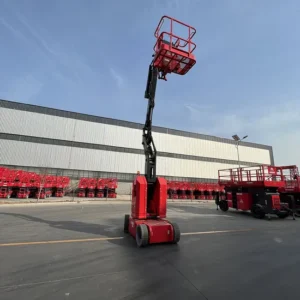
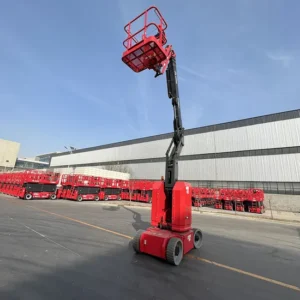
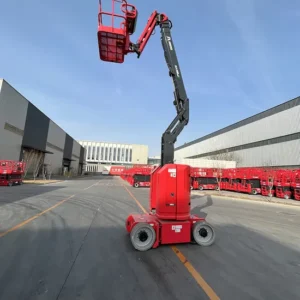
A boom lift is a mobile aerial work platform1 that uses hydraulic articulating or telescopic arms2 to reach elevated work areas, offering superior flexibility and obstacle clearance compared to traditional scissor lifts. It's the go-to solution for construction, maintenance, and industrial projects3 requiring precise positioning at height.
I've debugged these machines at 3 AM on freezing job sites and watched them save projects that seemed impossible. Let me walk you through what makes boom lifts essential equipment for modern elevated work.
When I first started working with aerial platforms, I thought all lifts were basically the same. I was wrong. The difference became crystal clear during a bridge maintenance project where we needed to reach under the deck.
A boom lift, also called an articulating aerial platform, uses one or more hinged sections or a telescopic arm to position workers at height. Unlike vertical-only lifts, it provides both horizontal reach and vertical elevation4, allowing operators to navigate around obstacles and access hard-to-reach locations.
The core design includes two main categories I work with daily. Straight boom lifts feature a single telescoping arm that extends directly outward and upward5, similar to how a crane operates. These excel at maximum height and outreach when you have a clear path to your work area. I've used 125-foot straight boom units for stadium lighting maintenance where we needed pure vertical reach with moderate horizontal extension.
Articulating boom lifts use multiple arm sections connected by joints6, creating an elbow-like structure. This design lets the platform navigate up and over obstacles, then down into confined spaces. During a recent refinery maintenance project, we used articulating units to reach pipe connections behind structural columns—something impossible with straight boom or scissor lifts.
The key components I check during every equipment inspection include the hydraulic system powering arm movement, the platform basket with control panel, the turret providing 360-degree rotation, and the base chassis with drive system. Electric models use battery packs for indoor work, while diesel units provide the power needed for rough terrain and heavy-duty outdoor applications.
What sets boom lifts apart from other aerial equipment is the combination of reach, maneuverability, and positioning precision. I can extend the arm 60 feet horizontally while 80 feet in the air, rotate the platform without moving the base, and make micro-adjustments to position workers exactly where they need to be. This level of control transforms how we approach elevated work.
Last year, I consulted on a warehouse expansion where the client initially planned to use scaffolding. After calculating setup time, labor costs, and repositioning requirements, we switched to boom lifts. The project finished three weeks early.
Boom lifts typically offer working heights ranging from 30 feet to over 180 feet, with horizontal outreach extending 20 to 80 feet7 depending on the model. This combination of vertical and horizontal reach allows single-position access to areas that would require multiple setups with traditional equipment.
The height advantage translates directly into productivity improvements I measure on every project. A 60-foot articulating boom can access work areas covering roughly 10,000 square feet from a single position, compared to maybe 400 square feet for a standard ladder setup. I've timed the difference—repositioning a boom lift takes 3-5 minutes, while moving scaffolding for the same coverage change requires 2-3 hours of crew time.
Different applications demand different height specifications based on my project experience. Building facade work typically needs 40-80 foot platforms, matching most commercial structure heights. Industrial facility maintenance often requires 60-100 foot reach for accessing tanks, pipes, and overhead systems. Stadium and arena work pushes into the 100-180 foot range for lighting, signage, and structural maintenance at the highest levels.
The relationship between height and outreach creates practical working envelopes I map out during project planning. A 60-foot boom might provide 40 feet of horizontal reach at maximum height, but 55 feet of reach at 40 feet elevation. Understanding these curves helps me position equipment optimally, minimizing moves while maximizing coverage.
Payload capacity decreases as you extend height and reach8—a critical factor I always account for in equipment selection. A platform rated for 500 pounds at minimum extension might drop to 300 pounds at full reach. I've seen inexperienced operators overload extended platforms, triggering automatic safety shutdowns that halt work until the situation is corrected.
| Height Range | Typical Applications | Average Outreach | Common Capacity |
|---|---|---|---|
| 30-45 feet | Warehouse maintenance, retail facilities | 20-30 feet | 500 lbs |
| 45-80 feet | Building construction, industrial plants | 30-50 feet | 400-500 lbs |
| 80-120 feet | Bridge work, large structures | 50-70 feet | 300-400 lbs |
| 120-180+ feet | Stadiums, towers, major infrastructure | 60-80+ feet | 250-350 lbs |
I'll never forget a chemical plant shutdown where we needed to inspect valves positioned behind a maze of pipes, conduits, and structural steel. Traditional access methods would have required dismantling systems just to reach the work area. The articulating boom lifted us up, over, around, and down into position without touching anything.
Articulating boom lifts can navigate complex environments by bending around obstacles, reaching over barriers, and positioning workers in spaces inaccessible to straight-line equipment. This capability eliminates the need for equipment relocation, reduces setup time, and enables work in congested industrial and urban environments.
The articulation advantage comes from multiple pivot points I control independently. A typical articulating boom has three to five joints allowing the arm to fold, extend, and angle in virtually any direction within its working envelope. During a recent building restoration, we accessed window frames positioned behind decorative architectural elements by extending up, angling over the obstruction, then lowering down to the work surface—all without repositioning the base unit.
Straight boom lifts offer different navigation benefits suited to specific scenarios. While they can't bend around obstacles, their telescopic design provides superior horizontal reach over barriers. I've used straight booms to extend 60+ feet horizontally over retaining walls, fences, and water features to access building facades from parking areas where we couldn't position equipment adjacent to the structure.
The practical impact on project efficiency is substantial based on my time tracking. On a stadium maintenance project, articulating booms reduced equipment repositioning by 70% compared to straight boom alternatives. Each repositioning sequence takes 10-15 minutes including travel, stabilization, and safety checks. Across a multi-week project, that's dozens of hours saved.
Safety improvements from obstacle clearance capability often get overlooked. By navigating around hazards rather than working adjacent to them, we maintain safer working distances from live electrical systems, moving machinery, and other risk factors. During power plant maintenance, this standoff distance is often mandated by safety regulations—boom lifts make compliance practical.
The rotation capability adds another dimension to obstacle navigation. Most boom lifts provide 360-degree continuous rotation at the turret, allowing platform repositioning without base movement. I can work around a building corner, rotate to face the new section, and continue without ever driving the unit. This matters enormously in tight quarters where maneuvering space is limited.
Early in my career, I watched a project grind to a halt when rental scissor lifts couldn't handle the muddy, uneven job site after a rainstorm. The contractor ended up paying equipment rental fees for three days of weather delays. That's when I learned terrain capability isn't optional—it's fundamental.
Rough terrain boom lifts feature four-wheel drive, high ground clearance, oscillating axles, and oversized tires9 designed for operation on slopes, mud, gravel, and uneven surfaces. This mobility enables work on undeveloped sites, outdoor construction projects, and locations where ground conditions would immobilize standard equipment.
The mechanical differences between standard and rough terrain models are significant from an engineering perspective. Rough terrain units use larger diameter tires with aggressive tread patterns providing traction in loose soil and mud. Standard models use smaller solid or foam-filled tires suitable only for prepared surfaces. The ground clearance difference is typically 8-12 inches versus 3-4 inches, allowing rough terrain units to navigate obstacles and uneven ground without high-centering.
Four-wheel drive and positive traction systems make the critical difference in challenging conditions. I've operated rough terrain booms on 25-degree slopes and in conditions where two-wheel drive units would simply spin wheels. The oscillating axle design allows wheels to maintain ground contact even when traversing severely uneven terrain, maintaining stability and control.
Gradeability specifications tell me what slopes equipment can handle safely. Most rough terrain booms are rated for 40-50% grades when stowed and 20-30% when elevated, compared to 20-25% maximum for standard models. During a hillside construction project, this capability let us position equipment on natural slopes without extensive site preparation or leveling work.
The practical application scenarios where terrain capability proves essential include construction sites before final grading, outdoor industrial facilities with unpaved areas, agricultural and rural utility work, emergency response situations on undeveloped land, and any location where ground conditions vary or weather impacts surface stability. I've used rough terrain booms in every one of these scenarios, and standard equipment simply wouldn't have functioned.
Tire selection impacts terrain performance significantly based on my field testing. Foam-filled tires prevent flats but offer limited traction on soft ground. Air-filled tires provide better shock absorption and traction but risk punctures. Solid tires are puncture-proof but transmit more vibration and perform poorly on loose surfaces. I match tire selection to expected ground conditions during equipment specification.
I've consulted on projects where power source was an afterthought during equipment selection, then became a major problem during execution. The indoor convention center job where diesel exhaust forced work stoppages. The remote site job where electric units ran out of charge with no access to power. These mistakes are expensive and completely avoidable.
Boom lifts are available with electric battery power for indoor and noise-sensitive applications, or diesel/gas engines for outdoor work requiring extended runtime and maximum power. Hybrid models combine both systems, providing operational flexibility across diverse environments and eliminating the need for multiple equipment types.
Electric boom lifts use rechargeable battery packs powering electric motors10 for all functions. The advantages I leverage on indoor projects include zero emissions making them suitable for occupied buildings, minimal noise levels around 60-65 decibels allowing work during business hours, and lower operating costs with electricity cheaper than fuel. The limitations include 6-8 hour runtime requiring recharge cycles, reduced power for rough terrain or heavy loads, and the need for charging infrastructure at the job site.
Diesel-powered units use combustion engines providing maximum power and extended operation. I specify diesel booms for outdoor construction, remote locations without electrical access, applications requiring maximum lift capacity, and rough terrain work demanding high torque. The tradeoffs include fuel costs, maintenance requirements, noise levels around 75-85 decibels, and emissions restricting indoor use.
Hybrid boom lifts represent the solution I recommend most frequently for projects with mixed requirements. These units can operate on battery power indoors, then switch to diesel for outdoor work or when extended runtime is needed. During a recent mixed-use development project, hybrid units worked inside the building on electric power, then switched to diesel for exterior facade work—one equipment type handled the entire scope.
The operational cost analysis I perform for clients shows significant differences across power types. Electric units cost approximately $15-25 per day in electricity, diesel units run $40-80 per day in fuel depending on runtime and fuel prices, and hybrid units fall in between based on usage patterns. However, rental rates also vary—diesel units often cost less to rent despite higher operating costs.
Runtime planning becomes critical for electric boom lifts based on my project scheduling experience. A fully charged unit provides 6-8 hours of active operation, but actual runtime depends on usage intensity. Heavy lifting cycles, frequent movements, and cold weather reduce runtime. I plan for mid-day charging on extended shifts or have backup equipment available to maintain productivity.
Three years ago, I responded to a site where an operator had extended a boom lift beyond its safe working envelope on sloped ground. The automatic leveling system detected the unsafe condition and locked out all functions before the unit could tip. That safety interlock potentially saved lives and definitely prevented a catastrophic accident.
Modern boom lifts incorporate multiple active safety systems including automatic leveling sensors, overload protection, tilt alarms, emergency lowering systems, and platform controls with dead-man switches. These integrated safety features protect operators, prevent equipment damage, and ensure compliance with OSHA and ANSI standards for aerial work platforms.
The primary safety systems I verify during every pre-operation inspection include platform overload sensors that prevent operation when weight exceeds rated capacity, automatically stopping all functions until the load is reduced. Tilt and motion alarms activate when the base unit exceeds safe operating angles, providing audible and visual warnings before automatic function lockout. Emergency stop buttons at both platform and ground controls allow immediate shutdown from either position in hazardous situations.
Platform control systems incorporate multiple operator protection features. Dead-man switches require constant operator presence—releasing controls immediately stops all motion. Function interlocks prevent simultaneous operations that could create unsafe conditions, like extending reach while rotating at maximum speed. Proportional controls allow smooth, precise movements reducing sudden jerks that could destabilize workers or materials.
The emergency lowering system provides ground-level operation when primary controls fail. I've used this feature twice in my career during hydraulic system failures, safely lowering elevated workers using backup mechanical or auxiliary power systems. This redundancy is mandated by safety standards and proves its worth during equipment malfunctions or power failures.
Fall protection integration points are built into every platform, providing anchor points for personal fall arrest systems. While platform guardrails serve as primary fall protection, I require workers to use harnesses and lanyards as secondary protection, especially in high-wind conditions or when leaning over guardrails during work tasks.
Stability systems maintain safe operation on slopes and uneven ground. Automatic leveling sensors measure base angle and prevent operation beyond safe limits—typically 5 degrees for most models. Outriggers or stabilizers on larger units extend automatically when required, expanding the stability footprint. Load moment indicators calculate the combined effect of platform weight, boom extension, and rotation angle, preventing operations that could exceed stability limits.
| Safety System | Function | Benefit |
|---|---|---|
| Overload Sensors | Detect excess platform weight | Prevents capacity exceedance |
| Tilt Alarms | Monitor base angle | Warns of unstable positioning |
| Emergency Lowering | Backup descent system | Ensures worker retrieval during failures |
| Function Interlocks | Restrict unsafe operation combinations | Reduces operator error risk |
| Platform Controls | Dead-man switches and proportional operation | Maintains operator control |
After years of hands-on work with boom lifts across hundreds of projects, I can confidently say they've transformed how we approach elevated work—combining reach, flexibility, and safety in ways that traditional methods simply cannot match. The right boom lift doesn't just complete the job; it completes it faster, safer, and more cost-effectively than alternatives.
A safety agency or standards-oriented source can verify that boom lifts are classified as aerial/mobile elevating work platforms. ↩
A workplace safety or technical reference can support the claim that boom lifts use extensible/telescopic or articulating boom mechanisms. ↩
A neutral occupational safety source can substantiate typical boom lift applications across construction, maintenance, and industrial settings. ↩
A standards or safety source can confirm that boom-type platforms provide outreach in addition to elevation, distinguishing them from scissor lifts. ↩
A safety or technical reference can verify the structure and movement of telescopic/straight boom lifts. ↩
A neutral safety source can support the definition of articulating boom lifts as jointed boom systems. ↩
A specification-based or technical source can verify typical outreach ranges for boom lift models. ↩
A safety or technical source can explain how rated capacity and stability depend on configuration, extension, and outreach. ↩
A technical or safety reference can verify the common design features that distinguish rough-terrain boom lifts. ↩
A technical or occupational safety source can confirm how electric boom lifts are powered and why they are used for indoor or low-emission work. ↩